What a ceiling is, and how to work one out
A proprietary blend gives you one number for a list of ingredients. That looks like no information at all. It is not: the order the ingredients are printed in turns the single total into a separate upper bound for every one of them.
US regulation requires the ingredients inside a blend to be listed heaviest first. If they total T and an ingredient is printed k-th, that ingredient cannot weigh more than T divided by k. That figure is its ceiling.
A ceiling is a limit, not a dose. It tells you what an ingredient cannot exceed, which is occasionally enough to settle a question outright.
The rule that makes it work
One line of regulation, and everything else on this page follows from it.
A dietary supplement label may group ingredients into a proprietary blend and give a single weight for the whole group. What it may not do is list them in an order of its choosing. 21 CFR 101.36(c)(2) requires the ingredients in a blend to appear in descending order of predominance by weight.
That requirement is easy to skim past, because it reads like a formatting rule. It is not. It is the only quantitative statement the label makes about any single ingredient inside the blend, and it is made whether the manufacturer likes it or not.
So the printed order is data. The first name is the heaviest and the last is the lightest.
The arithmetic, in one line
Why the total divided by the position is a hard limit and not an approximation.
Take a blend of n ingredients weighing T in total, listed heaviest first. Look at the ingredient in position k. Everything above it weighs at least as much as it does, so those k ingredients together weigh at least k times its weight.
Those k ingredients are part of the blend, so their combined weight cannot exceed T. Therefore k times the weight of ingredient k is at most T, which means ingredient k weighs at most T divided by k.
The whole method
ceiling of ingredient k = total ÷ k
There is no statistics in it, no assumption about formulation practice and no industry rule of thumb. It is a consequence of the ordering requirement, and it holds for every blend that obeys the regulation.
A worked illustration, which is not this product
The blend below does not exist. It was invented for this section so that the arithmetic can be watched without an argument about a real label getting in the way.
Imagine a label that prints Example Complex, 800 mg, with four ingredients listed inside it: A, B, C and D, in that order. No individual amount is given, which is legal. Nothing else about this product is stated, because there is no such product.
| Position | Ingredient | The division | Ceiling |
|---|---|---|---|
| 1 | A | 800 ÷ 1 | 800 mg |
| 2 | B | 800 ÷ 2 | 400 mg |
| 3 | C | 800 ÷ 3 | 266.7 mg |
| 4 | D | 800 ÷ 4 | 200 mg |
Scroll this table sideways →
Now suppose the published literature for C reports an effect at 250 mg a day, and the literature for D reports one at the same 250 mg. The two ingredients have identical requirements, and their positions answer differently.
- C sits third, with a ceiling of 266.7 mg. Its position allows the studied dose, with 1.07× of headroom. That is a permission, not a measurement: C could still be 20 mg.
- D sits fourth, with a ceiling of 200 mg. Its position forbids the studied dose, short by 1.25×. No split of this invented blend, however favorable, puts D at 250 mg.
One position over, and the question changes from unanswerable to answered. That asymmetry is the reason the method is worth knowing.
What a ceiling is not
Three misreadings, in order of how often they are made.
- It is not a dose
- A ceiling is the largest an ingredient could be. The true figure lies somewhere between that ceiling and nearly nothing, and the label does not say where.
- It is not an estimate
- An estimate would try to guess the split. This does not guess: it derives a limit that holds for every possible split, which is a weaker claim and a much safer one.
- It is not a verdict on the ingredient
- When a ceiling allows a studied dose, that says nothing about whether the ingredient works. It says only that the position does not rule the dose out.
There is also a fourth limit, and it is the one most likely to bite. A milligram of extract is not a milligram of anything in particular unless the label states a standardization — a marker compound percentage, an extract ratio, an elemental figure. Where a label states none, the ceiling is a bound on a raw material rather than on an active.
The real case: position four on this label
The same division, run on the bottle this site is about.
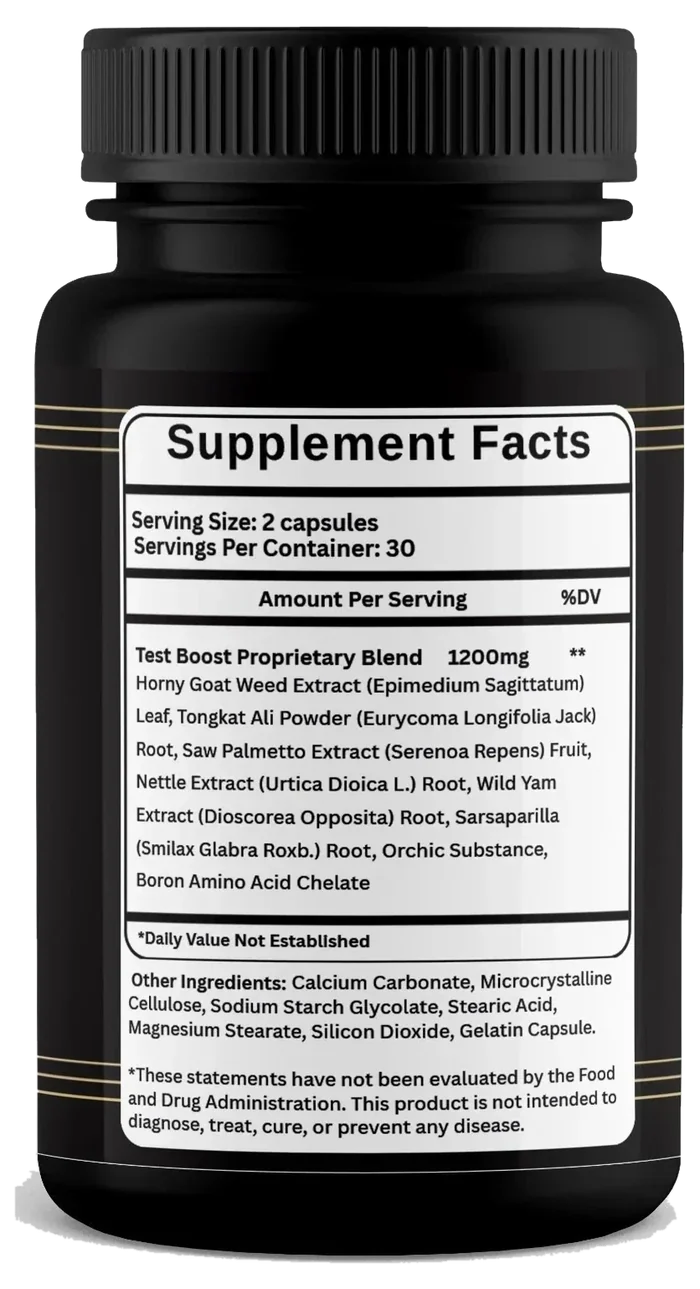
The Test Boost Proprietary Blend on the SodaPeak panel weighs 1,200 mg per two-capsule serving and contains eight ingredients. Fourth in the printed order is nettle extract, root. Its ceiling is 1,200 ÷ 4, which is 300 mg.
The lowest dose in the published human trials of nettle root is 360 mg a day. That is more than the ceiling. The position forbids the studied dose, short by 1.20×, and no split of the blend changes it.
This is worth being precise about, because it is a stronger statement than the ones around it. It is not that nettle root probably falls short, or that it is unlikely to reach a useful amount. Given where it is printed and what the total is, it cannot reach the dose that was studied. The label says so itself, in the only quantitative language it uses.
Three ways a ceiling argument can be wrong
The division cannot be wrong. The three things it is fed can be, and each one fails in a different direction.
The arithmetic takes three inputs from outside itself: a total, a position, and a dose to compare the answer against. Every way this method can mislead you is a fault in one of those three, so they are worth naming before anyone leans on a conclusion.
- The total is per serving, not per capsule. A blend weight is printed against a stated serving size, and on this panel that serving is two capsules. A reader who takes one capsule is working from 600 mg, not 1,200 mg, and every ceiling below it halves with the total. The side panel on this bottle says one or two capsules while the Supplement Facts panel describes two, so the ambiguity is on the label itself.
- The printed order could be wrong. Descending order is a requirement placed on the manufacturer, not a measurement made by anyone else. Panels are artwork, artwork is typeset, and this one carries a detail we can see: the blend line and the footnote are marked with two different symbols. If the order is misprinted, every ceiling derived from it rests on a false premise.
- An ingredient may be active far below its studied dose. The lowest dose in the literature is the lowest dose anyone has published a trial at. It is not a threshold below which nothing happens; it is where the funding for a trial happened to land. Absence of a lower trial is absence of evidence, not a floor.
Only the first of the three can be fixed by the reader, and it is fixed by reading the serving line before dividing anything. The second and third cannot be checked from outside the factory and the literature at all.
What survives all three is narrower than it first looks, and it is worth stating exactly. A ceiling that allows a studied dose establishes nothing: the true figure may sit anywhere beneath it, the order may be misprinted, and the dose it was compared against may be the wrong benchmark. Permission is not evidence.
A ceiling that forbids a studied dose is different, because it fails on the label’s own terms. If the panel is accurate, the dose is arithmetically out of reach. If the panel is not accurate, then the panel is not accurate. Neither branch gives a buyer a reason to expect the studied dose, which is why the negative conclusions are the ones this site is willing to print.
So the honest output of the method is a short list of impossibilities and a longer list of shrugs. That is less than a buyer wants, and rather more than a proprietary blend was meant to give up.
How to do this on any bottle
Four steps, and none of them needs anything you cannot do standing up.
Find the blend total
One number, next to the blend’s name, for a stated serving size. Check how many capsules that serving is; at half the serving, every figure below halves.
Count the position
Read down the list inside the blend and note where your ingredient is. First, second, seventh. That is your k.
Divide
Total divided by position. That is the ceiling, and it is the most that ingredient can be.
Compare it with a studied dose
Look up the lowest dose at which anything has been reported for that ingredient. If the ceiling is below it, the position forbids the dose and the question is settled.
The last step is the only one that requires a source rather than arithmetic, and it is the one where a site like this one earns its keep. The references below are the doses used on this page.
Why position four is the interesting one →Where the word came from →All eight positions, divided →
References
The sources behind the numbers on this page.
- U.S. Government Publishing Office21 CFR 101.36 — Nutrition labeling of dietary supplements, including the proprietary blend and descending-order requirements — Code of Federal Regulations · source
- Safarinejad — 2005Urtica dioica for treatment of benign prostatic hyperplasia: a prospective, randomized, double-blind, placebo-controlled, crossover study — Journal of Herbal Pharmacotherapy · DOI 10.1080/J157v05n04_01 · PMID 16635963 · source
- European Medicines Agency — 2012Assessment report on Urtica dioica L. and Urtica urens L., radix (EMA/HMPC/461156/2008) — EMA.europa.eu · source
- Men, and colleagues — 2016A systematic review and meta-analysis of Urtica dioica for benign prostatic hyperplasia — African Journal of Traditional, Complementary and Alternative Medicines · DOI 10.4314/ajtcam.v13i2.17 · source
See the SodaPeak packs
One, three or six bottles. The price is on the seller’s checkout page, because it is the one figure this site was never given — and a figure we were not given is not a figure we will print.
Shipping and the guarantee term are shown at checkout. This site publishes no number it was not able to verify.